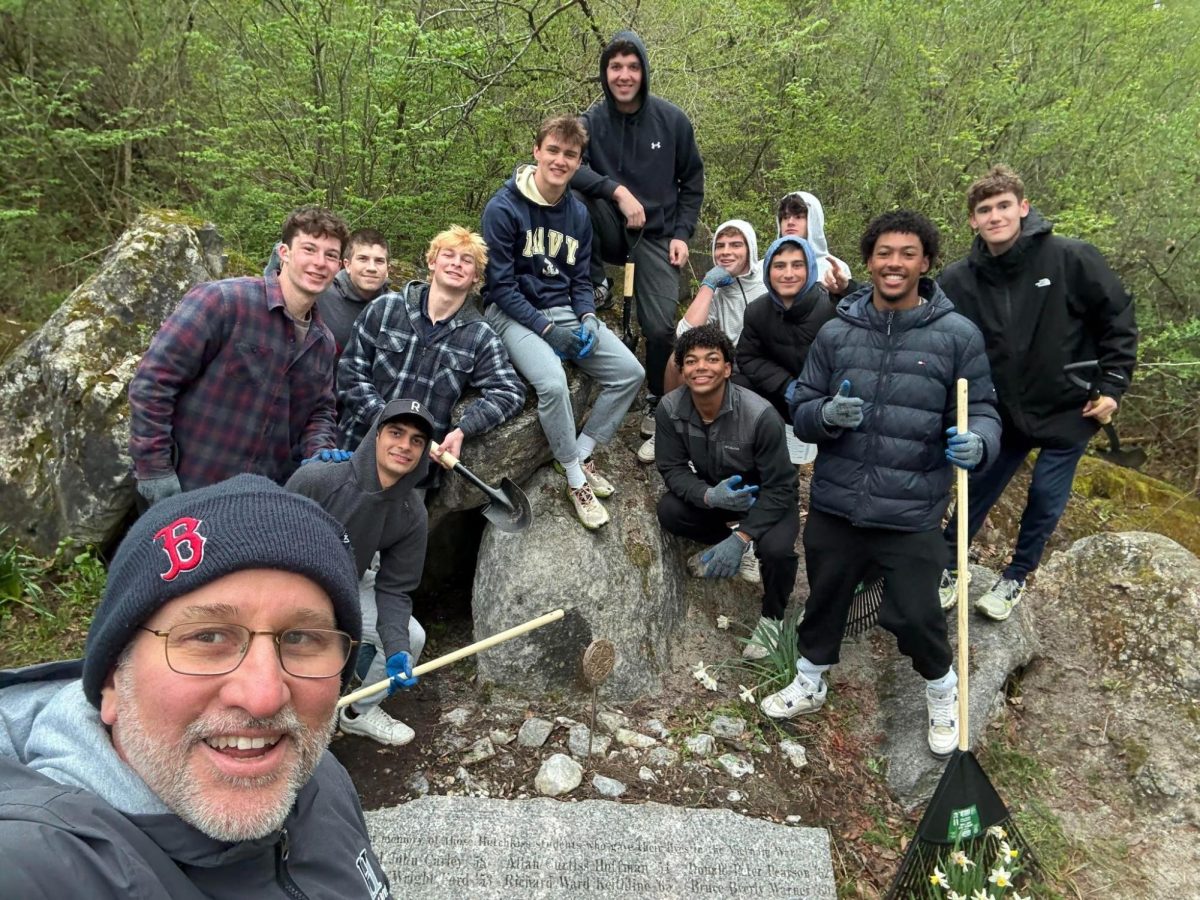
This Eco Day, the Veterans Club led a group of student volunteers in cleaning up a quiet and often overlooked corner of campus near the William and Martha Ford Indoor Tennis Courts: the Vietnam Memorial.
As Memorial Day approaches, the Veterans Club wanted to raise awareness for and honor our Vietnam War veterans, and restore a quiet place of thought and reflection for the six alumni who gave their lives as a result of their wartime service.
Prior to Eco Day, I decided to search the archives and investigate the origins of the memorial to uncover the identities of these six men. What I found was a narrative as jagged and remarkable as the story of the memorial itself, a story defined by complicated and often overlooked pieces of the history of our school and nation.
The origins of the school’s Vietnam memorial are as unconventional as the era that brought them about. From 1965 to 1972, college students across the United States protested the Vietnam War and the military draft. Many were furious that the U.S. government would throw citizens’ lives away for a war that they perceived to be meaningless. These protests spilled over to our school.
In the spring of 1971, a small group of students decided to organize their very own Vietnam War protest and skipped a full day of classes. They met in an open field north of the Tom Schmidt rink (now the area in front of the indoor tennis courts) to build a monument from limestone boulders excavated during the construction of the rink. At the time, the intent was not to create a permanent memorial, but to protest the war’s expansion from Vietnam into Cambodia. Bradley Lauderdale ’72 later recalled in a letter to the school that the event “drifted into farce as the half- dozen students realized that, without tools or a plan, their pile of rocks looked much the same at the end of the day.” Yet, Lauderdale noted a profound truth in his letter, observing that there was no real conflict between protesting the war and honoring those who died in it.
The monument reminds us that patriotism lies in the willingness to engage with the uncomfortable questions of our time.
The archives of The Record from October 1969 reveal a campus deeply divided by the Vietnam War. In an article, Seniors Harley Earl ’70 and Gordon Burns ’70 passionately debated the stark realities of the time.
Earl, who intended to enlist, argued that while a war might be morally wrong, the cause of defending individual freedom was morally right. He viewed service as a price he was willing to pay in return for his freedom. Conversely, Burns sought status as a conscientious objector (which allowed citizens to refuse military service for reasons of religion or conscience) and asked why the government was killing off the very people who might make us great: our own citizens. Ultimately, neither served in the war. Both went on to successful careers in finance after attending Yale and Princeton.
The school has a long history of military service by students and alums, from the pioneers of flight in WWI to the estimated 3,000 who served in WWII and Korea. However, in the decades following Vietnam, from the Gulf War to the Global War on Terror, a new trend has emerged. While some in our community continue to choose the path of military service, for the vast majority of students, service has turned into something that is someone else’s responsibility. While thousands of citizens have perished in Iraq and Afghanistan, the school has seen no recent names added to our memorials.
After cleaning up the Vietnam Memorial in 1997, students researched the names of the fallen and added a plaque to the pile of rocks. Among those honored on it are Donald Pearson ’62, whose mental wounds claimed his life a decade after his service in Vietnam ended. By cleaning the memorial again this year, the Veterans Club and its volunteers did more than just rake leaves. We reclaimed a space where the virtue of service and the conscience of the dissenter meet.
In an age of disconnection, these stones remind us that patriotism lies in the willingness to engage with the uncomfortable questions of our time, ensuring that for every name on that plaque, “in remembrance is redemption.”