On February 12, 2026, Ukrainian skeleton racer Vladyslav Heraskevych stood at the top of the track and prepared for his Olympic race. However, mere minutes before the men’s skeleton competition was to begin, the International Olympic Committee (IOC) announced that he was “not allowed to participate” in the games. His only crime? Refusing to take off his helmet.
Heraskevych’s helmet bore images of Ukrainians who lost their lives since Russia’s invasion in 2022, including figure skater Dmytro Sharpar, boxer Maksym Halinichev, and Heraskevych’s family and friends. “All of them were athletes or people closely related to sports,” Heraskevych said, adding that he wanted to “memorialize them” at the Olympics, so that, even though they were killed, “they still made it there.”
However, this beautiful tribute was rejected by the IOC. Heraskevych was promptly barred from competing because of “[refusal] to adhere to the IOC athlete expression guidelines.” His disqualification forces us to ask not only whether athletes should express political views at the Olympics, but who has the authority to decide what counts as “political” in the first place.
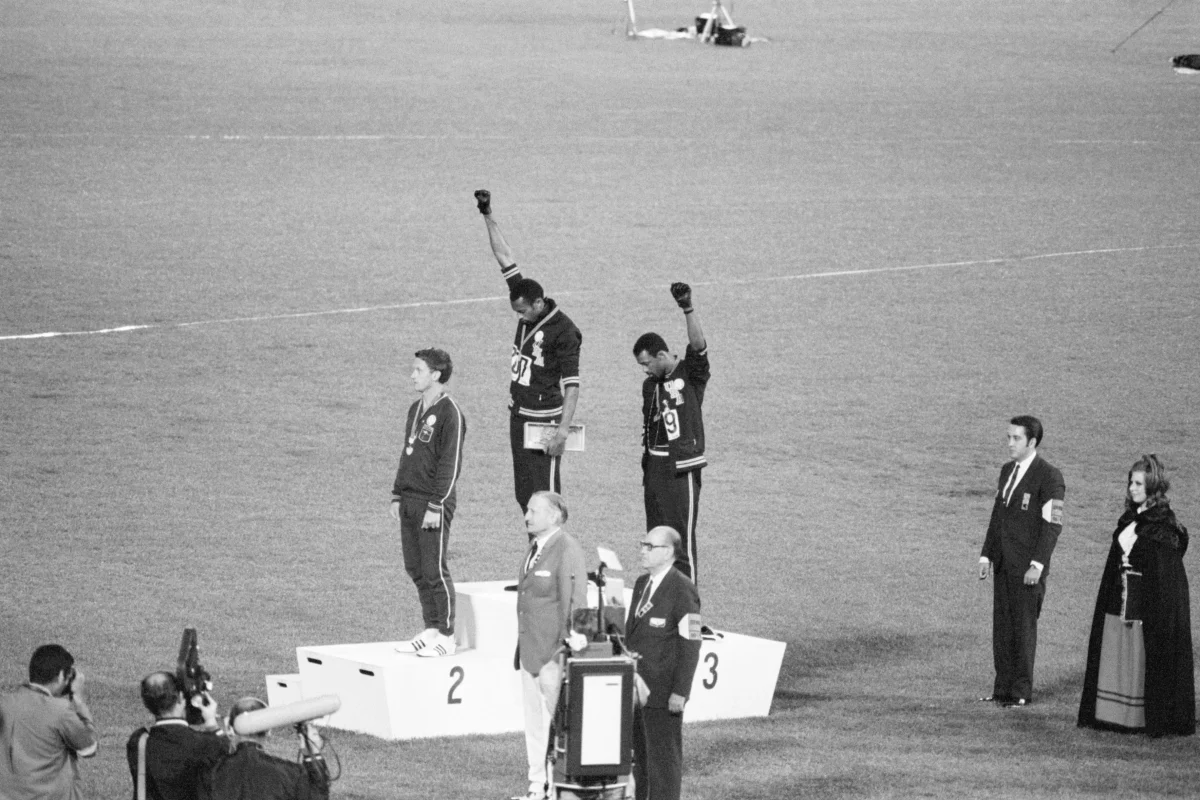
Rule 50 of the Olympic charter lies at the center of this debate. It states, “No kind of demonstration or political, religious or racial propaganda is permitted in any Olympic sites, venues or other areas.” Right off the bat, the wording of this rule is incredibly vague and invites subjective interpretations as to what counts as a political or religious demonstration. However, according to Time Magazine, this rule has been in place since the 1955 Olympic Charter and has been tightened over the decades, notably after the raised fists of 1968, which forced the IOC to codify and defend its position.
In 2021, the IOC consulted over 3,500 athletes from 185 countries to update its political expression guidelines. Seventy percent of athletes surveyed believed it was not appropriate to demonstrate on the field of play, and 67% believed the podium should remain protest-free. The IOC points to this as “democratic legitimacy” for its censorship of political displays, arguing that “[the] unique nature of the Olympic Games enables athletes from all over the world to come together in peace and harmony.”
On paper, the logic of Rule 50 is appealing in its simplicity—but it’s not as simple as the IOC makes it out to be. The claim of political neutrality is itself a political stance, and by deciding what counts as protest and what doesn’t, the committee is overlooking the fact that it is the most powerful political actor in the room.
Consider what the IOC did to Russia just four years prior to censoring Heraskevysch. Following the invasion of Ukraine, Russia was banned from Olympic competition. At Milan Cortina 2026, the consequences were sweeping. According to The Moscow Times, Russia had no flag, no national anthem, and no national team at the games. Athletes contracted to the Russian military or national security agencies were barred entirely, along with those who actively supported the war. Few would argue it was the wrong decision—but it was undeniably a political one.
The IOC looked at a war, assigned blame, and built rules around that judgment. There is, as the IOC would argue, a certain logic to this: the Olympic Games are built on promoting the principle of peaceful competition between nations. When that peace is violated, the countries that do so lose the right to participate in the Games. Russia instigated an unprovoked war on Ukraine, thus not properly upholding Olympic values, which let to them being banned from competing. So far, pretty consistent. But here is where the IOC’s reasoning collapses under its own weight. If the Olympics stand for peace, and Russia was excluded for violating that peace, Ukraine is not the aggressor in this story. The faces on Heraskevych’s helmet did not advocate for conflict; he only wanted to mourn the victims of an unjust war. To honor those who died defending the Olympic ideal of peace is not a violation of that ideal, but rather the most faithful expression of it.
The IOC’s mistake is treating all political gestures as equal— when they are not. There is a profound difference between a statement that sanctions a war and then silences its victims. By flattening that distinction, by treating remembrance the same as provocation, the IOC is abandoning its values.
Remember that the goal of the Games is inherently political: to bring nations together in peace. Thus, the IOC should stop pretending that politics has no place at the Olympics, and start being honest about which politics it stands for—and which ones it is willing to silence.
The current, underlying discord at the Games is evident right there in Cortina. While Heraskevych was being banned from wearing the faces of dead Ukrainian athletes, The Euromaidan Press reported that Italian snowboarder Roland Fischnaller competed on the same field of play wearing a helmet featuring a Russian flag, noting that this is a symbol explicitly prohibited under Olympic rules. When questioned, the IOC’s press office was unable to explain to the media why Fischnaller was able to circumvent the ban without incurring any penalty. The only explanation given was that the flags represented the countries he had previously competed for—an explanation that satisfied no one.
But this inconsistency runs deeper than one snowboarder. According to PBS News, American figure skater Maxim Naumov displayed a photo of his late parents, killed in a plane crash, on the field of play without penalty. Israeli skeleton athlete Jared Firestone wore a kippah with the names of the eleven athletes killed in the 1972 Munich Olympics Massacre, also without sanction. Both were acts of remembrance, in competition, of deceased loved ones, similar to Heraskevych’s. However, neither triggered a disqualification.
Further inconsistencies are revealed by past treatment of Heraskevych himself. As reported by CBS News, at the 2022 Beijing Olympics, Heraskevych displayed a “No war in Ukraine” sign after his fourth and final run, a direct political message, and the IOC ruled that he was simply calling for peace, and thus, found no violation of the Olympic charter. It was the exact same athlete, the exact same war, but four years later, a silent tribute of painted faces cost Heraskevych his Olympics.
All that being said, it is still worth pausing to take the IOC’s position seriously, because at its best, it is not an unreasonable one. The committee’s defense was never that Heraskevych’s message was inherently wrong. IOC President Kirsty Coventry said as much herself in a press conference regarding Heraskevych’s disqualification: “No one, no one— especially me—is disagreeing with the messaging.” The conflict, rather, was with the platform on which he shared message.
There are over 130 armed conflicts happening in the world right now, and if every athlete from every war zone, every oppressed minority, every humanitarian crisis, brings their cause onto the track or the podium, the Games cease to maintain their ideal image of peace, some argue. And crucially, for athletes competing under authoritarian governments, a political moment on the Olympic stage could mean retaliation, imprisonment, or worse when they return. Silence, in that reading, is protection for the athlete.
The purpose of this article is not to unilaterally criticize the IOC, but rather ask the reader to question political silence at the Olympics. When we enforce silence, it may seem as though we keep “politics” off the field, but in reality, we only manage to keep one side of the political reality out while the other remains unchallenged.
More often than not, what gets protected are the accounts of those in power. When the IOC silences a Ukrainian athlete honoring his dead, it does not protect him—it protects the narrative of the country that murdered them. The sooner the IOC ceases to pretend that neutrality is all it can ever stand for, the sooner the Olympics might become what it has always claimed to be: a reflection of the world’s best self.