When I was younger, I truly believed my grandpa, John Thornton, had everything figured out. He worked as a forensic scientist from 1963 to 2003 and became the most published forensic scientist in the United States. To me, his life looked like a clean, perfect line of success, like he was born knowing exactly what he wanted to do, and then just did it brilliantly. Over Thanksgiving break, I asked him how it feels to be at the very top of your field. His answer shocked me. He said he often felt like a fraud. Even with all his publications, awards, and famous cases, he still doubted his own abilities.
Hearing that from someone I admire so much changed something in me. It made me realize self-doubt isn’t a sign that you’re doing badly; it’s something that even the most accomplished people carry with them. In fact, the most accomplished people often have more self-doubt, because they’re constantly pushing themselves. But what stands out to me is the fact that my grandpa never let that doubt stop him. He loves solving mysteries. He loves piecing together evidence in a way others can’t. That passion carried him through late nights in the lab, through uncertainty, through pressure that never seemed to let up. Passion and doubt can exist at the same time. But if all you feel is doubt with nothing to balance it, it will slowly eat away at your motivation and joy.
At Hotchkiss, I see this everywhere. We go to a school, now ranked #1 on Niche, filled with people who excel in everything: academics, the arts, athletics, and every random hobby you can imagine. And yet so many of us feel like imposters. Others’ achievements loom over us, dwarfing our own. It reminds me of how my grandpa must have felt working with other top scientists in his field. The worst part is that this self-doubt doesn’t only make us feel insecure, it steals the spark we once had. I used to love writing, or taking on science projects just because they felt exciting. Now, sometimes I view myself as average, my writing as clumsy, my ideas as not good enough.
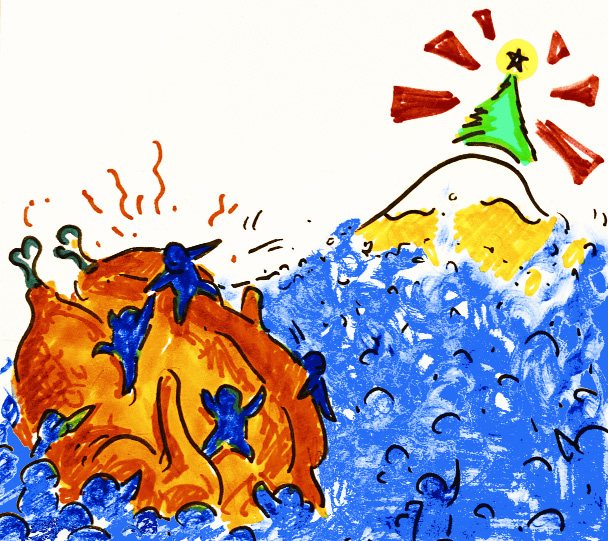
And this leads us to right now: this wild, intense, two-week stretch between Thanksgiving and winter break. The race to the holidays.
We’re not just tired, we’re completely drained. We cling to the countdown because it feels like the only thing keeping us going. Every day becomes a box to check off, closer to that moment where we finally get to breathe. And during this race, everything becomes about performance. You hear people say, “I need to get this grade on the final or I’m done,” or you find yourself typing your assignment scores into RogerHub to see what you need for an A. (I have done this way too many times, and trust me, it just stresses you out more.)
But this frenzied comparison, pressure, and measuring of ourselves chips away at the reason we came to Hotchkiss in the first place. We came because we love learning. Because we are curious. We wanted to push ourselves, not because we needed to be perfect, but because it felt good to grow. And now, halfway through the year, it’s hard to remember that. Instead of actually learning, we cram information from flashcards just to get by on the next test.
During this countdown, we forget what drew us here. Hotchkiss is about curiosity and joy. My grandpa didn’t pursue forensic science for fame or recognition; he did it because he loved the challenge and the mystery. And I think many of us came here for a similar reason: to explore ideas, to create, to grow in ways that matter to us. But when daily life becomes a grind of grades and deadlines, that purpose gets blurry. Passion gets pushed aside. The race to the holidays becomes a race away from ourselves.
Recognizing this pattern is the first step toward breaking it. Yes, the holidays are important; they reset us. But they shouldn’t be the only reason we keep going. We need to stop letting self-doubt run our lives and instead reconnect with passion, reminding ourselves why we’re here and what we really care about. It means studying a subject because it actually interests you, or creating something just because the process is fun. When we start doing that, the race to the holidays becomes less desperate.
I’ve been trying in my own tiny ways—by writing without judging every sentence, learning something new purely because I’m curious, and reminding myself what I love about each class or project. These moments don’t erase doubt, but they do bring back that spark.
Self-doubt will never disappear. My grandpa carried it, and so do I. But it doesn’t have to define us. If we pause, reflect, and reconnect with our purpose even a little, the race to the holidays can become something totally different. Not a sprint for survival, but a firm reminder of what keeps us going.