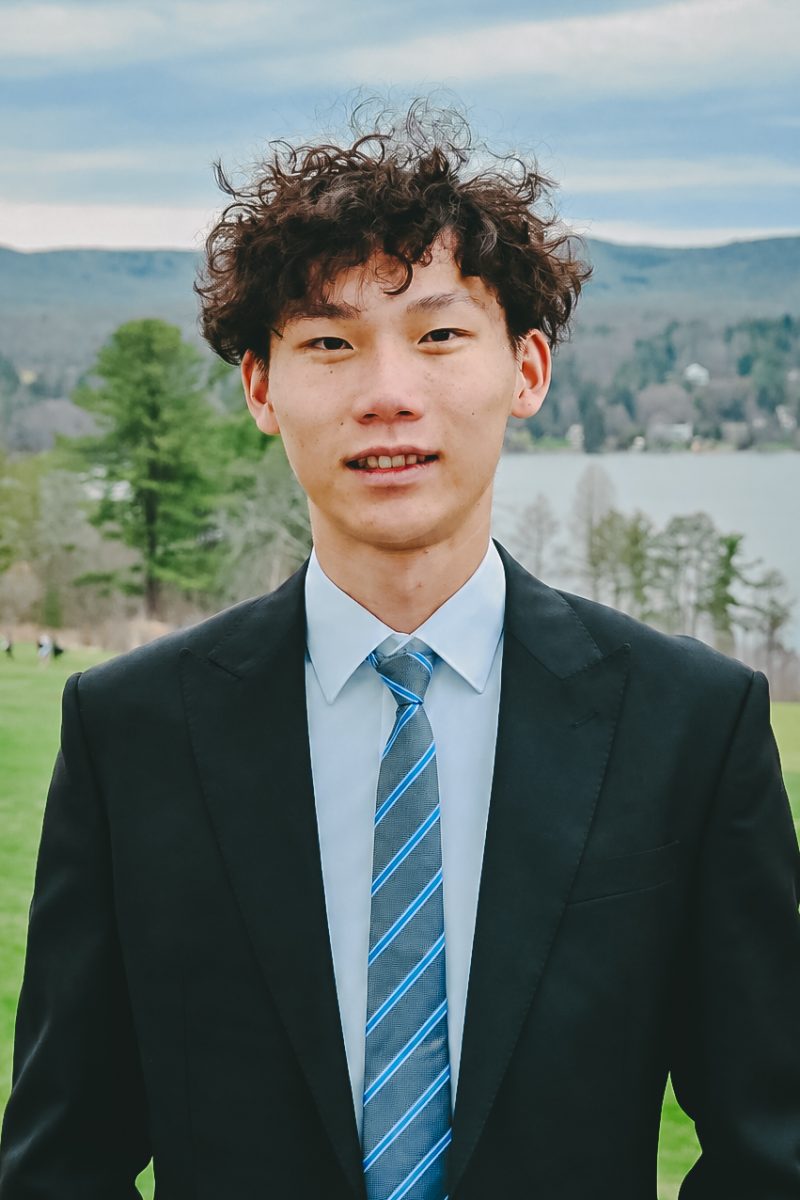

Rikako Umezawa ’27:
Life at Hotchkiss operates with a quiet perfection. When my dad visited for the first time, he looked around and joked, “This place is nicer than most colleges,” and he’s not wrong. We have a brand-new dining hall opening on December 1 with stunning architecture and new food stations. The library feels like something out of a university campus, our athletic facilities are top-tier, and the school offers programs that send students overseas to learn, compete, and volunteer throughout the year.
Yet for most of us, these extraordinary resources fade into the background as an unremarkable part of our day-to-day.
Last year, for an English project, I was tasked with designing a memorial for Frederick Douglass that reflected his life and values. As I walked around campus looking for inspiration, I began to notice all the different memorials we have. Small, bronze plaques reading “In honor of,” “Dedicated by,” and “A gift from” are everywhere. I found them on benches outside the science building, on the trees near VS dormitory, and next to the weight room.
These spaces and opportunities exist because people chose to give back to our community. Take Hurst Hall, for example. Its refurbishments, made possible by a major donation, have modernized a historic building while meaningfully enhancing student life. With updates like the newly renovated common room, the space houses students and faculty in a way that feels more connected. That’s what giving does: it creates spaces for people to thrive together for years to come.
It can be easy to take this privilege as a given. When you can fly to another country for a history trip or use professional-level athletic equipment without thinking twice, you forget that these opportunities are exceptional.
When I think about alums who give back, I imagine they do so not just because they cherished their time here, but because they want future students to experience the same—or even greater—possibilities. At Hotchkiss, donor culture is about making gratitude visible. It’s the same idea that shaped my Douglass project: a memorial isn’t only a tribute to the past, it’s a responsibility to carry forward the values that matter most.
When the new dining hall opens in just a couple weeks, I know most of us will be excited about the food and the beautiful space. But I hope we also take a moment to appreciate what this building represents. It represents the generosity that sustains our community, the gratitude that connects generations, and the belief that progress is something we build together.
Alex Jiao ’27:
The community is buzzing with excitement for the new dining hall to open, complete with a brick oven for fresh pizza, brand new seating areas, and a variety of other flashy amenities. Large-scale projects like the dining hall or the recent renovation of Hurst Hall, are undeniably valuable investments. The development of these projects relies heavily on donor generosity, a system that is essential but poses challenges when it comes to balancing competing priorities.
Hurst Hall, previously Memorial Hall, underwent much-needed refurbishments made possible by the Hurst family’s support. I admire the beauty and modernity of the building, now one of the best places to live on campus. I was startled, though, when the decision to rename the dorm was announced suddenly in all-school only a day before it took effect. The name “Memorial” carried weight, honoring alumni who have served the country. It was a tribute to those who deserve a lasting place in our school’s memory.
By rededicating the dorm to recognize the new donor family, the administration undermines the history and emotional significance behind its old name.
Although the school recently created Memorial Quadrangle, this gesture feels like an afterthought to cover up the loss. One family’s financial generosity—important as it is—has displaced a commemoration that stood for more than a century, dating back to the dorm’s construction in 1923.
I understand the necessity of thanking our donors. I do not, however, agree with sacrificing history and tradition to express that gratitude.
Each of the school’s decisions about how to use donations requires trade-offs. The luxuries of our new dining hall excite me endlessly and are sure to reinvigorate the community through the wintertime. Yet I also wonder about the allocation of funding across the school’s many priorities.
New building projects are naturally appealing to donors, providing visible progress and lasting proof of their generosity. High-profile renamings and celebrations only heighten this appeal, signaling to students and alums alike that these large projects are the most valued and rewarded forms of support. Yet other acts with profound impact—like expanding financial aid—remain largely invisible, even though they matter as much. Even without knowing the exact allocation of funds, it’s hard to ignore how major capital projects can draw attention and momentum away from these less visible priorities.
The school is constantly making difficult decisions about what to prioritize, striving to balance improvements to buildings with preserving history, all while supporting the students in meaningful ways. The pressure to keep donations flowing weighs heavily on these decisions.
I wonder what our campus will look like when I return in five or 25 years. I am sure that the facilities will still be state-of-the-art, but I wonder whether the character I value most about this school will persist. Will our financial aid and diversity programs expand and develop alongside the physical campus? These developments, while perhaps not as exciting as the new dining hall, are what strengthen our school’s legacy for years to come.