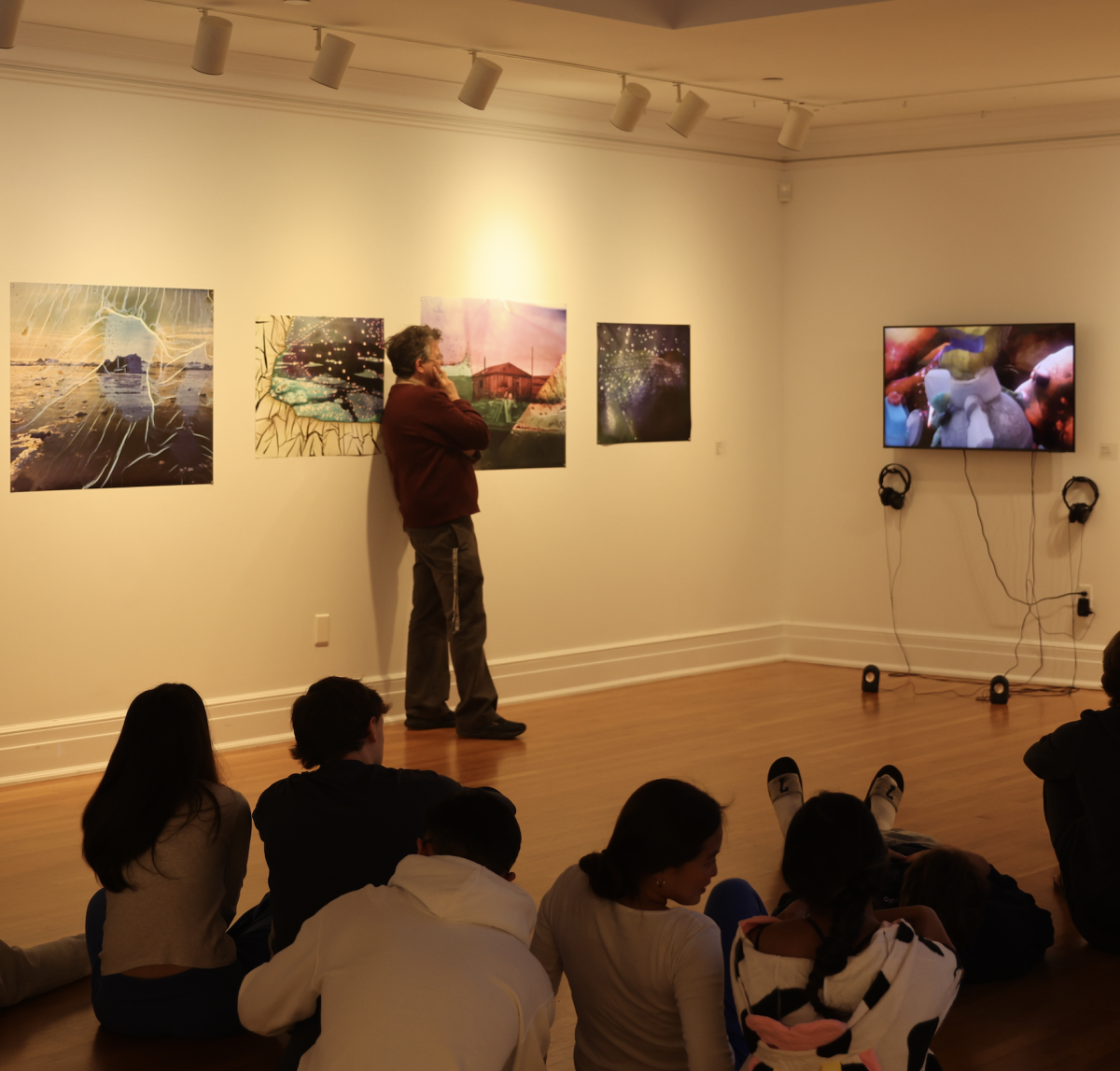
On April 21, the exhibition “Vulnerable Earth” opened in Tremaine Gallery. Curated by Mr. Greg Lock, director of photography, film, and related media, the exhibit features artwork created by 19 artists, including Mr. Lock. They were inspired by their experiences at The Arctic Circle Residency, which is associated with the Open Bay Centre for Art and Science.
According to the residency’s website, it brings together “international artists of all disciplines, scientists, architects, and educators who collectively explore the high-Arctic Svalbard Archipelago and Arctic Ocean.” As the northernmost ecological region on Earth, the High Arctic is a biome that spans over northern Canada and parts of Eurasia. The art featured in “Vulnerable Earth” captures the effects of climate change in the High Arctic Region, including the deterioration of ice caps.
Over the past 50 years, the Arctic Circle has experienced rising temperatures at a rate six times greater than the global average. Mr. Lock said, “It’s rapidly changing. If you went to the library and got a book on Svalbard, it would say it’s a polar desert. But it rains there now; it’s no longer a desert.”
“I went with the question, how do I capture and savor this landscape?” said Mr. Greg Lock.
To capture the irrevocable damage taking place in the region, the artists traveled together to examine an uncharted area of Svalbard. Recent climate change has made the area accessible for the first time. Mr. Lock said, “We were able to get to a lagoon, and the only reason we could get to the lagoon is because the sea was no longer frozen, and we were the first ship ever to go in the lagoon.”
“Vulnerable Earth” features images of ice caps, collage, and textiles. Mr. Lock said, “This was a fascinating project. When you go to the Arctic, you experience the landscape intimately.” The exhibition features an assemblage of techniques—for example, featured artist Charles Binns used only a simple plastic camera to capture pictures focusing on biodiversity loss. The resulting images show the bright ice caps through a dreamy but somber filter. Mr. Lock said, “As a photographer and an artist, I’d be taking pictures of this amazing ice form, looking at the rocks, or just meditating.”
Every piece in the exhibition showcased a distinct style and was inspired by the relationship between the landscape and the artist. Mr. Lock said, “I went with this idea of how do I capture and savor this landscape? But Ella [a featured artist] goes there in a really experimental mode where she prepares film and dips it in all kinds of chemistry…so it’s different for everyone.”