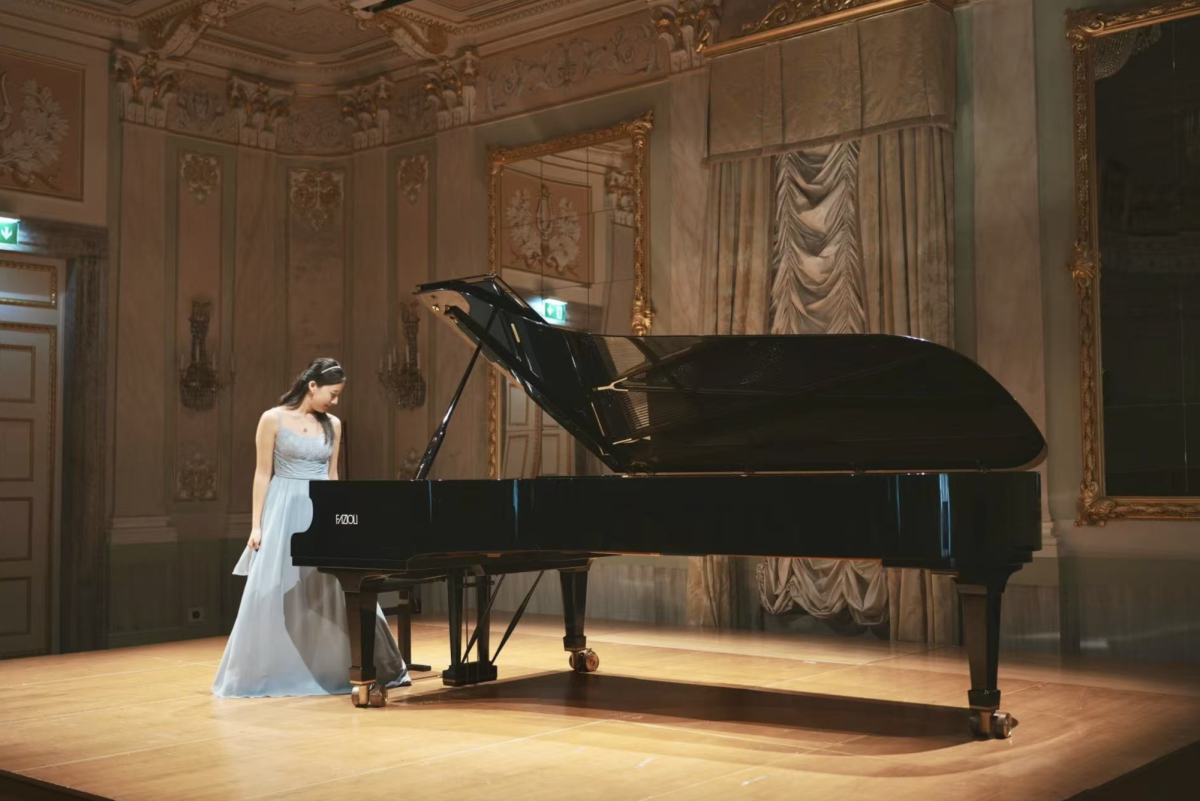
Emma Liu ’26 is a four-year Senior from Moorestown, NJ. She plays piano and cello in the orchestra and Philharmonic and is a piano major in the Juilliard Pre-College Program. Liu was the founder of Twinkling Little Stars, and is co- head of Songs for Smiles and a member of Calliope. Outside of music, she is co-head of Korea Club, a former Arts Editor of The Record, and member of Girls Thirds Tennis. She will pursue piano performance at Princeton University next year.
How did you get started with the piano and what made you stick with the instrument?
My journey with the piano began as my mother’s childhood dream. She bought a piano so she could learn to play, and watching her as a young child fascinated me. When I was five, I started learning alongside her, working through the Suzuki books together. My dad was our greatest cheerleader; he helped me find fun in playing. My parents have been my biggest supporters ever since, though my mom never lets me forget that she used to be better than me!
It was my first-grade talent show that made me stick with piano. It was the first time I performed for a public audience, and while I had always enjoyed playing for fun, the exhilarating feeling of playing for others changed everything.
What does a typical week look like for you, balancing academics and Juilliard Pre-College?
The expectation at Juilliard Pre- College is for students to practice four to five hours a day, but that isn’t possible with the Hotchkiss lifestyle. I’ve had to learn how to condense my practice into about two hours a day.
I spend most afternoons in the practice room. I also try to chip away at my Juilliard homework throughout the week so it doesn’t pile up by Saturday. This is especially crucial during midterm weeks, as both schools always schedule midterms at the same time.
The six-hour round-trip commute to Juilliard every Saturday is also very valuable. I do the work that requires internet or a desk before I leave, and save the reading or offline assignments for the train.
What is a favourite memory or concert from your music career?
Performing for international audiences in Spain and Italy with Hotchkiss was very special, but the experience that meant the most to me was my graduation recital at Juilliard.
I performed one piece from every year of my high school career, which served as a perfect capsule of how much I’ve grown over the last four years. It was a chance to play for the people I care about most: my sister, my parents, my extended family, my teachers, and my friends from Hotchkiss who come to all of my concerts. Being able to play what I love for the people I love was incredibly special.
Looking back, what’s something you wish you understood earlier about becoming a musician?
For a long time, I played piano to fulfill the requirements of exams or competitions. Since coming to Hotchkiss, I’ve started learning pieces just for myself, pieces I’ve never played for anybody else. While some might see that as a waste of time, it was essential for me to figure out who I am as a musician. It has enhanced my personal spin on my repertoire, helping me find the balance between the tradition of the composer and my own modern musicianship.
Hotchkiss also rewarded me with a new kind of independence. In elementary and middle school, my practice was very routine and supervised. Here, I have the freedom to experiment and practice on my own terms. Being surrounded by people who play different genres has also inspired me to branch out; I’ve started dabbling in jazz and songwriting.
What has been the biggest obstacle in your music journey, and how have you overcome it?
There was a time when I lost sight of why I played classical music. At recitals, I’d look out and see a small audience of local community members or students who were only there for attendance. It felt empty compared to the high energy of the Pep Rally or the musical theatre productions. It was disheartening to think that something I’d dedicated years to was really just someone’s background study playlist.
My perspective shifted during my trip to Spain and Italy. Through masterclasses and playing on historic pianos, I realized I’m part of a continuing human conversation much bigger than myself. I’ve come to understand that the value of music isn’t measured by how many people are listening, but by the fact that it’s a truly universal language.
How have you used your music to give back to your community, and what have you learned from those experiences?
Songs for Smiles was my way to engage with the local community, by performing at Noble Horizons and Sharon Health Care. In my upper class years, I started Twinkling Little Stars, which allowed me to explore the teaching side of music.
I’ve learned that teaching is a reciprocal act. I’m passing on my experience, but I learn just as much from the children I tutor. They have such unique perspectives and ask inquisitive questions that make me rethink why music is the way it is.