Katharine Ellis ’26
The festivities of this past week—such as the 100 days of school celebration and numerous evening sessions of interviews for The Record—have made me extra sentimental about my last couple of months here. While sitting in room 306, listening to eager, young writers as they expressed their passion for the paper, I couldn’t help but think back to my three experiences being in their very same seat. Sitting across the table, I was suddenly hit by the realization of how far I had come in my three short years working for The Record. It’s a crazy feeling to think back to my early writing days, tracking down unresponsive interviewees, and addressing Mx. Wynn’s plethora of corrections on my submissions.
As I look back on my growth, if my time with the paper has taught me anything, it is simply to try. Show up for things you care about. Step out of your comfort zone. I was often worried that my work wasn’t good enough or that I was doing something incredibly wrong as an editor or writer. Despite this, I kept showing up, putting in the work, and improving each week. Whether you are an avid writer for The Record or have never picked the paper up in your life, I am confident this guiding attitude will aid some part of your Hotchkiss journey. It has definitely shaped mine.
Jack McCarthy ’26
The first article I wrote for The Record was a Features piece interviewing Amy Yang, the owner of Golden Wok in Millerton. I put apostrophes on the wrong side of class years, misplaced commas, and wrote exclusively in the passive voice. This had been why I originally signed up to write for The Record: I wanted to improve my writing. Over the next few issues, I got fewer and fewer comments on my articles—though still plenty—and started feeling more assured. But just as I was finding my footing as a writer, I was promoted to editor of the Opinion section.
Editing felt like a whole other beast. How was I, a Prep, going to critique Upper Mids and Seniors whose writing was significantly stronger than my own? On top of that, I needed to immediately learn to use InDesign, a software I had falsely claimed to have experience with on my editor application. My co-editor, Sophie Perkel ’24, was two grades ahead of me and seemed like the smartest person in the world. Sophie’s patience with me was infinite, and our year editing together was the largest shaper of my writing today.
Shaye became my next co-editor, and the growth continued. Shaye’s energy and creativity brought new life to the Opinion section, inspiring my attitude as an editor and motivating me to do more than the bare minimum. I was ecstatic to continue working with her as Editor-in-Chief and even more so to be joined by Katharine, whose work as a News Editor I had admired from across our shared desk in SB202.
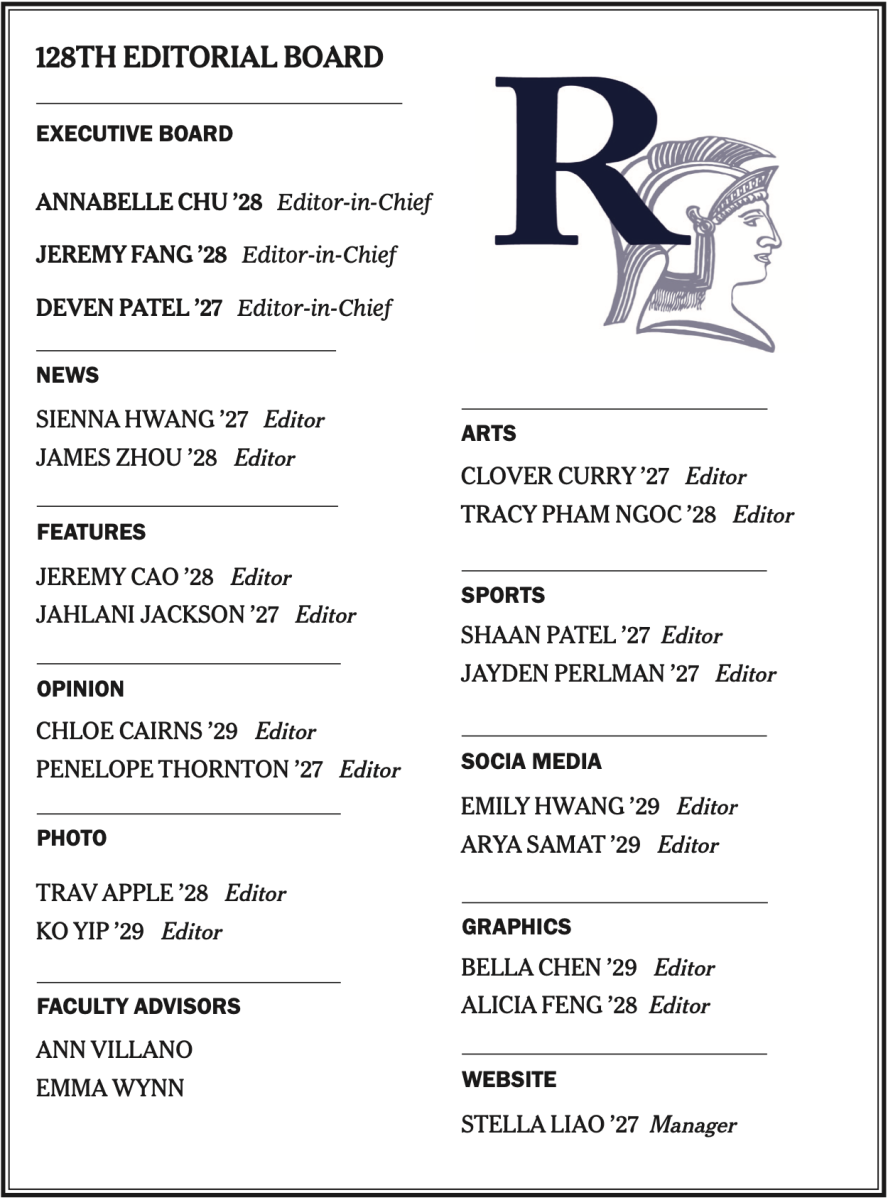
Over the past year, the three of us have probably spent hundreds of hours together, groaning over misaligned text boxes and laughing at ridiculous typos. Working with these co-editors—and Ms. Villano and Mx. Wynn!—has been the highlight and privilege of my time on The Record. My growth as a leader, writer, editor, and InDesign user is entirely a product of these relationships. To Jeremy, Annabelle, and Deven, I have full faith in your ability to lead The Record and hope that the three of you will enjoy working together as much as I have with Katharine and Shaye.
Shaye Lee ’26
There are many downsides to pottering around on the hamster wheel of school commitments: the blue-light image of the Canvas dashboard permanently stains the underside of your eyelids, your posture curves into the solution graph of the polynomial you failed to simplify last math class, and in a biological marvel somehow resistant to five cups of coffee or any amount of compensatory rest, you are always sleepy. But the worst of these consequences by far is that you rarely have time to think. Sure, your No. 2 pencils are sharp and prepared to dutifully scribble down whatever subject your teacher is lecturing on; but your critical awareness—your ability to process what these ideas really mean and apply them to your interactions with the external world—has eroded to a dull nub.
For me, the only way to restore this important and necessary skill—the ability to think—has been writing. To verbalize an idea you must engage with it, a mandate that at the very least forces us to 1) search for new and interesting ways to give voice to ordinary thoughts or 2) reflect seriously on the ideas and experiences we’ve absorbed. We come to revelations as we write—one does not precede the other. What’s more, writing is practice for the most fundamental dimension of human existence: communication. Learning to articulate what we think and what we feel is essential to being understood by, and to understanding, others.
This brief reflection can lead to two conclusions: 1) that nobody should outsource the process of contortionist thinking that writing insists upon by using AI, and 2) that everybody should write for The Record. I credit this newspaper for strengthening the process of articulation which I view as essential for any meaningful life, and that’s why I encourage anyone— regardless of their writing ability—to contribute to it.