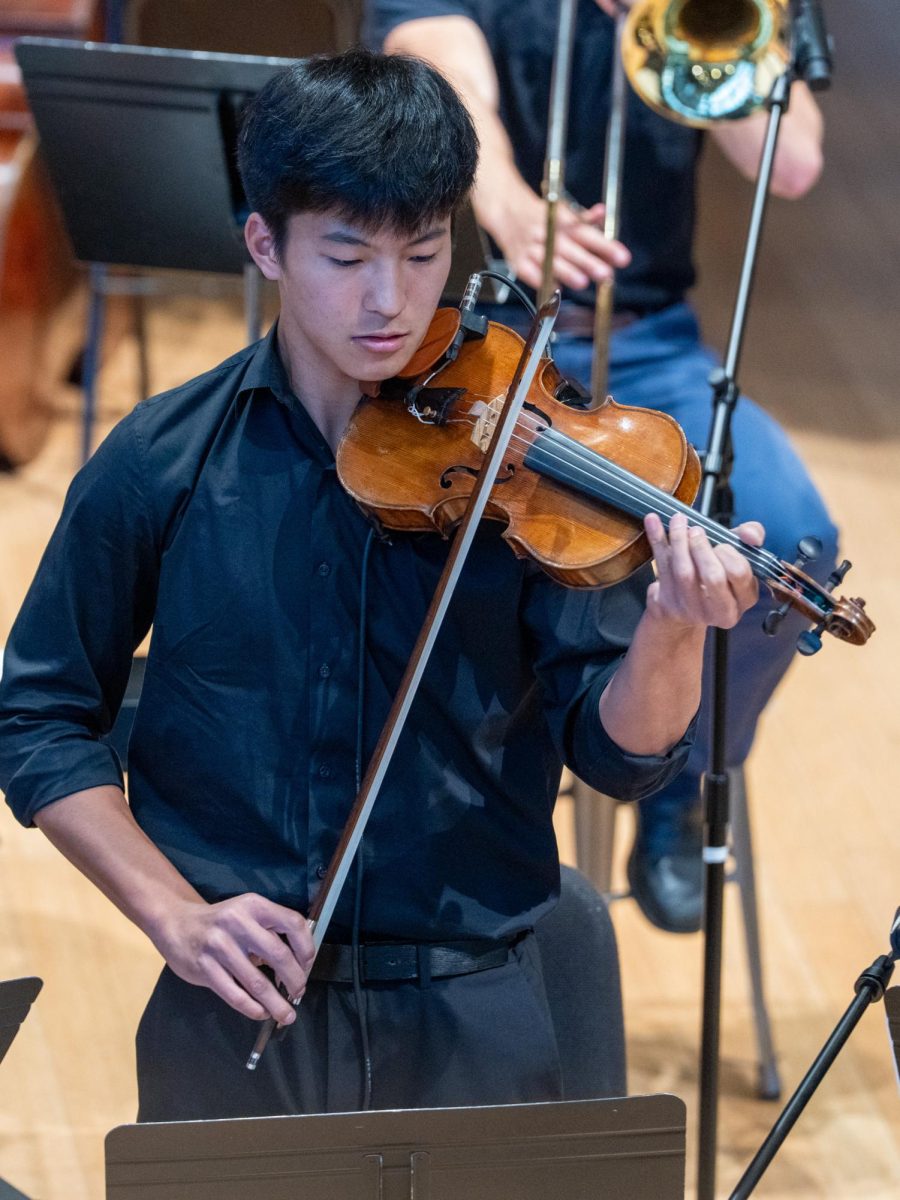
Andrew Lee ’26 is a four-year Senior from Sydney, Australia. He plays violin with Right Brain Logic jazz band ensemble and attends the Manhattan School of Music every Saturday. Outside of music, Lee is a member of Boys Varsity Wrestling and Varsity Ultimate. He is also the senior advisor for Songs for Smiles and a co-head of Eudamonia.
How did you start playing the violin?
I began in middle school, when I started at the Elizabeth Morrow school, which has a renowned string program. I love the violin and the sound of it—I think it’s a very lyrical instrument. It’s one of the closest in resemblance to the human singing voice.
I switched to the jazz violin because while classical music is cool, it wasn’t right for me. I enjoyed some parts of the music, but it often felt repetitive and minimalistic. We’d talk about how to phrase certain pieces in terms of what the composer wanted, which felt very restrictive.
As an artist, I think you have to learn to express yourself. In some ways, music is an embodiment of your identity, so it just didn’t feel like classical was that for me.
How has the school’s music program helped you grow as a musician?
The facilities here are world-class, and the access to the equipment at Hotchkiss are unmatched. We probably have the best music facilities out of any of the boarding schools.
I think Elfers is gorgeous. I practice on the stage all the time, and the acoustics are incredible. For jazz musicians, living on campus is very important, as you get to play and rehearse with other musicians.
How do you improvise and come up with solos?
I think improvisation is methodical and liberating at the same time. You have to really respect the jazz tradition and you have to listen to a lot of the jazz greats—the musicians that came before you—and what they did with their improvised solos.
Jazz solos are a lot like speaking a language. There’s a lot of vocabulary words and sentences that make up the tradition. You need to understand what those are and represent that in your playing.
Your solos should be a representation of your identity and what you think sounds great to you.
You have to listen to a lot of recordings, play with a lot of people and understand what jazz is really about to appropriately improvise. But it is also a really spur-of-the- moment thing, which I think is beautiful.
It’s interesting with solos, because it really reflects how you’re feeling in that moment. Sometimes you walk into band practice and you may just start playing, but if you’re feeling just really sad that day, that will show up in your playing.