Nestled among the misty hills of Jiangxi Province, the city Jingdezhen has been known as the Porcelain Capital of China for over a thousand years. Its delicate ceramics, born from earth and fire, embody the very essence of refinement, resilience, and radiance of Chinese artistry.
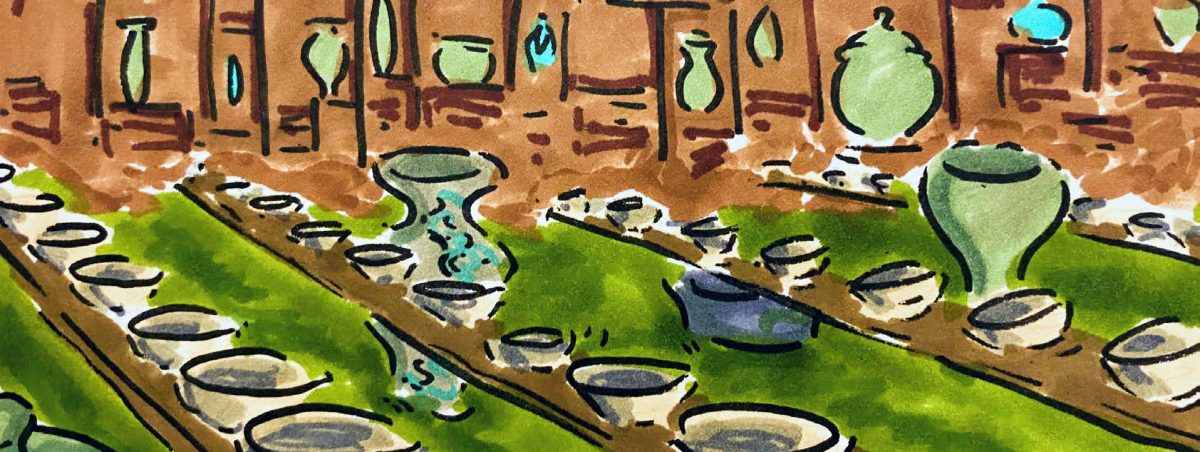
I witnessed the making process of Qinghua porcelain when I visited the ancient imperial kiln site of Jingdezhen. An old craftsman dipped his brush into cobalt pigment and traced a dragon’s tail onto a porcelain plate. His hands moved with practiced steadiness, showing the confidence of an experienced artisan who had spent decades perfecting each line and curve. Every stroke of his brush was soft but accurate, as if it were a breathing extension of his body. Watching him, I realized that the spirit of Jingdezhen lies in the quiet devotion of those artisans who shape it.
Early forms of Porcelain making in Jingdezhen began during the Eastern Han Dynasty (220 CE), and art flourished under the Song (960-1279) and Ming (1368-1644) dynasties as advances in technique were made and the town became the imperial kiln center. The name Jingdezhen honors Emperor Zhenzong (968-1022) of the Song Dynasty, who decreed that royal porcelain be inscribed with “Made in the Jingde Era.” As a result, this mountain town transformed from a humble pottery village into the heart of China’s ceramic glory.
Jingdezhen produces four main kinds of porcelain: Qinghua porcelain, Famille Rose porcelain, Linglong porcelain, and color glazed porcelain.
Qinghua porcelain was first created during the Yuan Dynasty (1271-1368). The most recognizable form of Chinese porcelain with its iconic two-tone palette of blue and white, it is made by painting designs with cobalt pigment onto the clay body, glazing, and firing at high temperature. The clear, bright glaze and vivid blue decorations create a refined and layered aesthetic.
Famille Rose porcelain, developed in the late Kangxi period of the Qing Dynasty (1644-1912), uses a soft overglaze enameling technique. Artisans outline patterns on fired white porcelain, then apply colored enamels and fire at 600-900 degrees celsius. The result is a delicate finish with gentle hues and elegant floral motifs.
Linglong porcelain, which originated in the Ming Dynasty, is developed from openwork carving techniques. Artisans carve out rice-grain-shaped holes following floral or geometric patterns on a thin porcelain body and coat it with transparent glaze.
Colored porcelain uses natural minerals and metal oxides as colorants mixed into the glaze. Colored porcelain has a wide variety of colors and types including monochrome glazes with a single color throughout such as red glaze, yellow glaze, and celadon glaze.
Today, Jingdezhen remains a living museum of porcelain culture. Artists from around the world gather there to learn traditional techniques and experiment with modern designs. Through its centuries of artistry, Jingdezhen allows the world to see beauty in patience, perfection, and persistence.