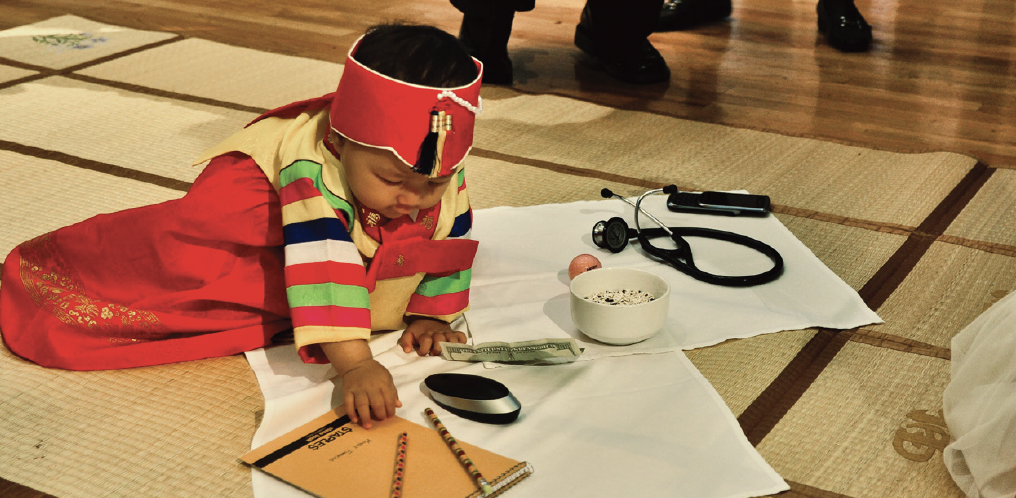
In the faded photograph on the refrigerator door, my Doljabi is frozen in time, the bright colors of my hanbok standing out against the wooden floor, a golf ball, a stack of money, a bowl of rice, and other objects arranged around me. My first time wearing a hanbok was during my Doljanchi, the Korean first birthday ceremony that celebrates a child’s survival through infancy and invites blessing for a long, successful life. The entire family gathers in celebration, feasting on traditional foods like miyeokguk (seaweed soup) and tteok (rice cakes). The highlight of the Doljanchi is the Doljabi, where the baby picks from an assortment of items to predict their future profession or fortune; I chose a stethoscope, the symbol of a future medical career. As the years went by, my hanbok has stayed tucked away in the back of my closet, but even just through the photographs, I can feel my family’s joy, pride, and connection to my culture.
Hanboks are traditional Korean clothing; “han” literally translates to “Korean” and “bok” to “clothes” or “attire.” Their origins go back to the Three Kingdoms period, and the style we recognize today developed during the Joseon Dynasty. With their loose and flowing style, which pairs a short jacket with a long skirt or wide pants, hanboks allow for comfort and freedom of movement. In the past, people of all ages and social classes wore them everyday, with fabrics, colors, and patterns that often reflected social rank, age, and special occasions. Bright colors were worn for celebrations, while muted tones were used for daily life or by elders. Embroidery and decorations added layers of meaning to hanboks. Peonies and cranes signified wealth, happiness, or long life, while tigers and phoenixes symbolized courage and protection. For royals, hanboks were often decorated with dragons and gold or silver emblems, to show their status and authority. Family crests displayed a person’s lineage, and smaller designs of animals or plants were added to bring good luck, safety, and other virtues. They represent identity, tradition, and the values people have passed down over time.
The next time I’d wear a hanbok would be during my first visit to South Korea eleven years after my Doljabi. My mother took me to Gyeongbokgung Palace, a cultural landmark that was the largest and primary royal palace of the Joseon Dynasty in Seoul. To completely immerse myself in the palace’s culture, I chose to wore a hanbok during my visit. Having grown up seeing the palace and its beautiful hanboks in countless K-dramas with my grandmother and sister, wearing one myself while exploring the Gyeongbokgung courtyards felt especially memorable; it was as if I were experiencing the Joseon era firsthand!
While I felt a little out of place, being one of the only non-Korean speakers there, my experience at the palace made me feel more connected to my Korean side. Wearing my hanbok, I felt proud to carry my culture and finally understand how it keeps tradition alive.