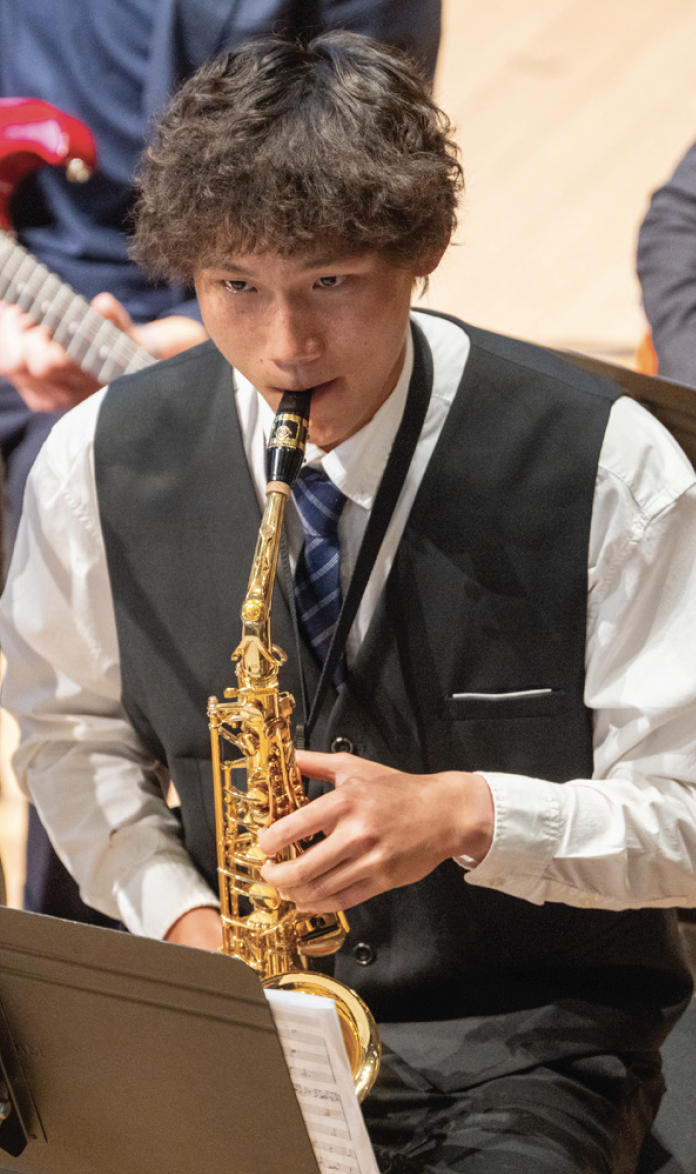
Mark Zhu ’26 is a four-year Senior from Suzhou, China. He is a member of the Right Brain Logic jazz band ensemble and plays the alto saxophone. Outside of music, Zhu is a co-captain of Boys Varsity Rowing. He is currently a proctor in Dana.
How did you discover your passion for the saxophone?
I began my music journey playing the piano. I played it for five years, but I honestly couldn’t find joy in it. I then moved to playing classical saxophone, and I started listening to a lot of jazz saxophone music by John Coltrane. I fell in love with the sound of the saxophone and how free jazz music sounded in general. Hearing masters like Claude Delangle and John Coltrane inspired me to find and develop my own voice on the instrument.
What are your experiences and perspectives on classical and jazz music?
I first studied classical music and played in my primary school orchestra, and I’ve been a classical musician for most of my life. I only began studying jazz after arriving at Hotchkiss. I love both styles for different reasons: classical music is beautiful and carefully structured, while jazz is incredibly free and expressive. What many people don’t realize, though, is that jazz requires just as much discipline as classical music. When I practice improvisation, I spend hours running scales and patterns in every key, transcribing, and listening closely to great players. That practice structure is what eventually allows improvisation to feel spontaneous.
How has the school’s music program helped you develop as a musician?
I’ve been a part of the Right Brain Logic jazz ensemble during all of my four years here. I love collaborating with other musicians and learning how to improvise. Studying with Mr. Tokarz, Mr. Jensen, and Mr. Musillami has helped deepen my understanding of jazz. On the classical side, the program has offered incredible opportunities, including instrumental recitals and performing at Carnegie Hall. These experiences pushed me to refine my technique and build confidence as a performer.
What challenges have you overcome as a musician?
When I first started doing jazz music, improvising felt daunting and impossible. I felt stressed before every single rehearsal, because when the conductor pointed to me to improvise, I was put on the spot. Nothing came out when I first started. I listened to a lot of jazz music, paid attention to how the greats played and phrased their tones, and practiced a lot of licks. Now, improvising comes more naturally to me.
In performance, I would say that 50% of what I play is the stuff I’ve practiced, like the runs that I’ve memorized, and the other 50% is completely imagined on the spot. There are tricks that you learn that can apply to all scenarios, but there’s definitely a free aspect to improvisation, where you pull something out that’s completely new.
Do you plan to pursue music in college?
I plan on joining the MIT Festival Jazz Ensemble or the MIT Wind Ensemble. I might also minor in classical music.